AI & API Orchestrator
Orchestrate APIs, data, systems, and AI agents on a single platform
From fragmented ecosystems to connected operations, with the governance your company needs to put AI to work securely.
Companies that already flow with us
- BTG Pactual
- Santander
- C6 Bank
- Qive
- Accor
- Pearson
- Musashi
- Payfy
- Elos
- HomeAgent
- Angeloni
- Azzas 2154
- Board Academy
- Orbenk
- Asaas















The Problem
Fragmented systems can't handle the era of AI agents
Every company that tries to get AI to act on its systems runs into the same obstacle: no one is orchestrating what's already scattered, and the AI inherits the chaos instead of solving it.
- $4.7T
in value lost to disconnected systems
Accenture, 2023
- 87%
of executives say slow integration limits innovation
Forrester, 2022
- 6+ months
to complete regulatory integrations in 57% of banks
PwC, 2023
- 30%
of the IT budget consumed by manual integrations
McKinsey, 2022
How It Works
A layer that connects, governs, and scales everything your company operates
Without replacing what already works: Fluid integrates your systems and records every decision made by AI Agents.
Connect
Choose from 100+ ready-to-use connectors or build your own. Plug & Play with ERPs, CRMs, banks, and APIs.
See connectors →Effect: reduces months of point-to-point integration.
Orchestrate
Design visual flows, transform data, and activate AI Agents with clear rules on what each can do.
Effect: reduces rework and provides traceability for every automated action.
Scale
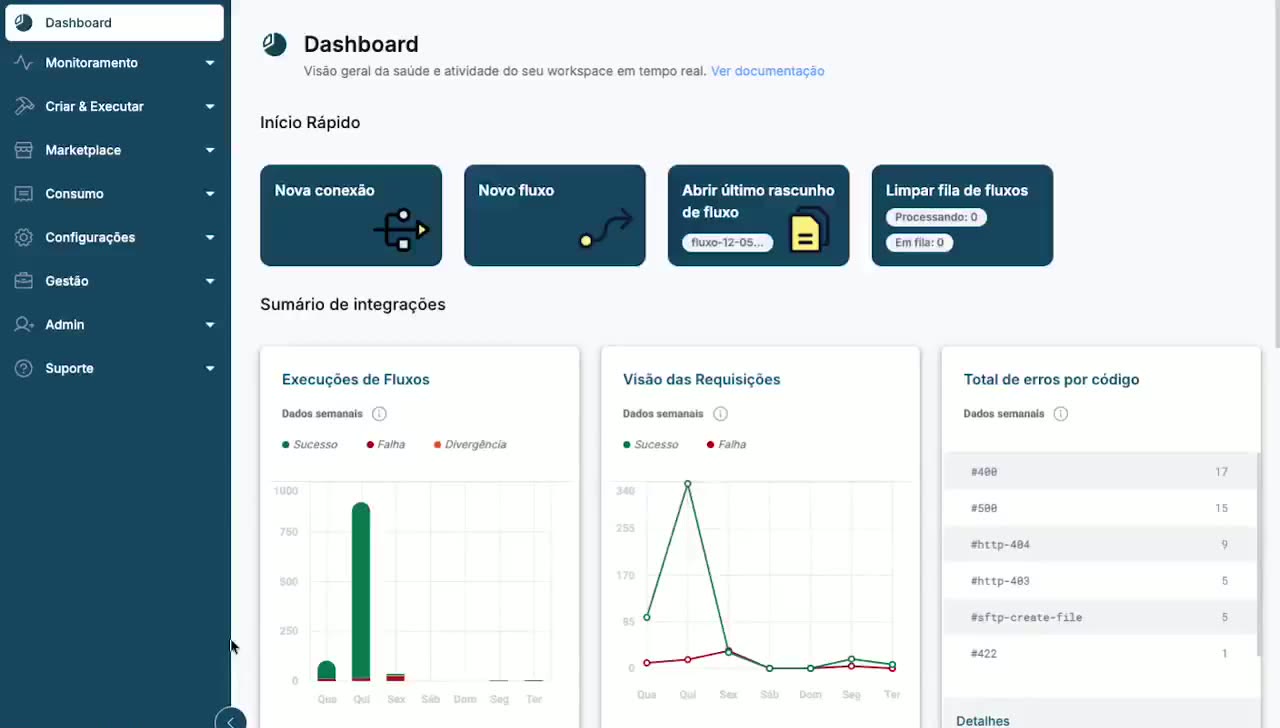
Monitor in real time, with built-in governance controls and NoOps operation. Fluid handles the infrastructure management.
Effect: grow without multiplying your operations team.
Platform capabilities
One orchestration layer. Many ways to use it.
Fluid sits between your systems and everything that consumes them. iPaaS, API Management, RPA, AI Agents, MCP and Embedded Integration Marketplace are the ways this layer is used, with the same governance.
- Systems
- ERPs
- SaaS
- Banks
Fluid
Orchestration and governance layer
- APIs
- Automations
- Applications
- AI Agents
iPaaS & Integration
Connect ERPs, CRMs, and legacy systems to modern APIs with low-code, without sacrificing central governance. 100+ ready-to-use connectors and reusable FlowKits.
Automations
API Management
Create, publish, and manage APIs with a built-in gateway and centralized governance.
APIs
AI Agents
Autonomous agents that monitor, optimize, and operate integration flows with embedded artificial intelligence.
AI Agents
MCP: Model Context Protocol
Turn your flows into tools of an MCP Server governed by Fluid. AI agents can use ERPs, CRMs and APIs under the same access and audit rules.
AI Agents
Embedded Integration Marketplace
Offer integrations as a feature of your product via Iframe or SDK. Your customers can activate connectors on their own, without opening a support ticket.
Applications
Security & Compliance
PCI-DSS, LGPD, OAuth2, SAML, encryption in transit and at rest, and complete auditing. Enterprise-grade by default.
Governance
Fluid + MCP
From the systems you already have to AI agents
The integrations Fluid already orchestrates become tools of an MCP Server. Agents like Claude, ChatGPT or Cursor can use ERPs, CRMs and APIs with the same governance as your flows.
- ERP / CRM / APIs
- Fluid Flow
- MCP Tool
- AI Agent
Embedded Integration Marketplace · for B2B SaaS
Integration as part of what you sell
Put Fluid inside your product via API, SDK, or Iframe. Your customers choose and activate integrations from a catalog with your brand, and integration stops being backlog to become part of your offering.
- Each end customer is isolated, with their own billing
- A FlowKits catalog that grows without rewriting the core
- Activation by the customer themselves, without opening a ticket
Business outcome
What orchestration changes in practice
More speed, more governance, and less operational effort, with room for new products and revenue.
Faster integration and product launches
Ready-made connectors and templates shorten the path from idea to go-live.
Less engineering backlog
Integration requests no longer compete for space with the product roadmap.
Lower maintenance cost
Authentication, errors, and retries are handled once on the platform, not in every integration.
Integration as a feature of your SaaS
Your customers activate integrations within your product, under your brand.
AI Agents in production, with governance
Every agent action follows defined rules and is logged for auditing.
Security & Governance
Governance that security leaders can defend internally
Every flow, API, and AI agent orchestrated by Fluid operates under access, encryption, and audit controls, not as an extra layer, but as part of the orchestration.
Encryption in transit and at rest
Data protected in transit and at rest throughout the cloud-native architecture.
OAuth2, SAML, and OIDC authentication
Federated access control, compatible with the identity stack your company already uses.
PCI DSS Certification
Certified as of 2025 for card data: encryption, access control, continuous monitoring, and vulnerability testing.
LGPD
Personal data processing considered in the design of every flow.
Workspace isolation
The data and flows of each workspace are isolated from one another.
Control over AI agent actions
Rules define what each agent can do, and every action is logged and auditable.
Fluid by the numbers
Proven scale in production
requests processed in 12 months
flows created in 12 months
connectors
customers
Why Fluid
One engine to orchestrate systems, APIs, and AI agents.
Ready for a new generation of integrations, where systems, APIs, and AI agents need to operate under the same governance.
Faster go-live
Ready-made templates + AI Copilot accelerate time-to-market and reduce dependency on large squads.
Plug & Play
One-click or API activation. Faster deployments, with less IT dependency.
Real-time traceability
Logs, alerts, dashboards, and automated auditing. Visibility into every transaction and flow.
Infrastructure managed by Fluid
Native Kubernetes, GitOps, and autoscaling. Less operational effort for your team, so they can focus on the business.
Solutions by Industry
Every industry, a challenge.
One platform for all.
Specific solutions for your industry's integration challenges.
Fintechs & Banks
Open Banking, Embedded Finance, regulatory compliance. Connect ERPs to banks with PCI-DSS security.
Learn more →B2B SaaS
Embedded integrations as a feature of your product. Your customers activate connectors via marketplace or API.
Learn more →Manufacturing
Connect the factory floor to the ERP. Synchronize MES, WMS, logistics, and supply chain in real time.
Learn more →Retail
A sale in any channel updates the stock in all others at the same moment, whether in the marketplace, your own e-commerce, or the physical store.
Learn more →Agribusiness
Agribusiness cooperatives and companies connect ERP, fiscal data, and logistics in a single flow, without relying on manual integrations between harvests and systems.
Learn more →
Success Stories
Who already orchestrates with Fluid
- Fintech
BTG Pactual
Business credit marketplace with client-activated integrations, reducing technical dependency.
Deal closed with integration as a competitive differentiator
- Hospitality
Accor
Global orchestration connecting hotel systems to the ERP with 24/7 availability in 110 countries.
Accelerated financial closings, with fewer manual errors
- Industry
Musashi
MES + ERP integration with millimeter precision in inventory control and automotive production.
Reduced production line stoppages due to lack of integration
"We needed to integrate government systems with our own, which was completely outdated, and we had a tight deadline. Half of our revenue was at stake, and Fluid was our salvation!"
 Marcos GuerraIT Manager, Pearson Brasil
"We needed to create differentiated automation models, and Fluid helped us a lot in this process by creating easy-to-integrate connector models. So today, we are very happy with this partnership."
 André Lucas MarcelinoIntegration Coordinator, Asaas
"Usually you spend a year on analysis before a year of implementation. Here we did the analysis and the implementation in eight months. The impact was huge!"
 Laurice MachadoExternal Consultant, Accor
"When we hired Fluid, the implementation was super fast: within days everything was organized. Fluid made it so much easier to build integrations with our customers."
 Gabriel MelloCEO, Proxpect
"Now we have a fluid, fully automated process that is faster and less costly. With Fluid, besides the trust, the decision is natural, because we save at least 50% of the time and cost."
 André Pereirae-Commerce Manager, NB Indústrias
Ecosystem
Learn, connect, evolve
Fluid Academy
Training tracks: Foundation, Professional, and Expert. From onboarding to advanced operations.
Access Academy →Community
Technical discussions, best practices, and collaborative problem-solving among clients, partners, and experts.
Join the Forum →Documentation
Complete guides, API reference, tutorials, and examples to accelerate your implementation.
View Docs →
Frequently Asked Questions
What you need to know
- Orchestrating means that Fluid doesn't just connect systems: it coordinates, in an automated and governed way, everything that happens between them: API traffic, data flows, automated processes, and the actions that AI agents perform on these systems. This gives your company a single layer of control and visibility over an operation that, without orchestration, would be scattered across dozens of isolated integrations.
- Fluid treats iPaaS, API Management, AI agents, MCP, and Embedded Integration Marketplace as capabilities of the same orchestration engine, with a single governance layer. In practice, this means support for MCP to connect LLMs to real systems, clear rules about what each agent can do, and 100+ ready-to-use connectors that accelerate go-live.
- iPaaS (Integration Platform as a Service) is a cloud-based platform that allows you to integrate systems, data, and applications without developing point-to-point code. In Fluid, iPaaS is one of the capabilities supported by the orchestration layer, alongside API Management, AI agents, and MCP, and not the complete definition of what the platform does.
- Yes. Fluid was designed to connect legacy systems to modern APIs. We have native connectors for ERPs like Senior, SAP, and Sankhya, as well as support for TOTVS, Salesforce, and dozens of other systems. The integration is done without needing to refactor the existing system: Fluid acts as the orchestration layer between your systems.
- Embedded iPaaS allows B2B SaaS companies to offer integrations as a native feature of their product. With Fluid's Embedded Integration Marketplace, your customers can activate connectors via Iframe or SDK/API directly in your software's interface, without depending on your technical team. It's like having an integration store inside your product.
- Yes. Fluid operates with PCI-DSS and LGPD compliance, authentication via OAuth2, SAML, and OIDC, and a cloud-native architecture with encryption in transit and at rest and the principle of least privilege (PoLP). We already serve clients like BTG Pactual and Santander in environments with high regulatory requirements.
Ready to orchestrate
the future of your integrations?
Talk to our experts and discover how Fluid can transform the way your company connects systems, data, and AI.